
AN INDEPENDENT RESEARCH PROGRAM
Chaitanya Laxman
Warnings are debts
Bhopal was warned in print, four times. Challenger was warned the night before. Wuhan punished the warning. Why hearing was never the bottleneck, and what would make warnings ownable.
In September 1982, a journalist named Rajkumar Keswani began publishing warnings in Rapat, his small Hindi weekly in Bhopal. He had spent months with plant workers and leaked safety reports from the Union Carbide pesticide factory on the edge of the city, after a leak there killed a worker, and what he found frightened him enough to run a headline that translates as: save this city. He followed it two weeks later with another, and another after that, each more specific about the failing safety systems around a chemical called methyl isocyanate. In June 1984 he tried one last time, in a national daily now: Bhopal, he wrote, was sitting on the brink of a disaster. On the night of December 2, 1984, about forty tonnes of methyl isocyanate escaped from that plant and drifted over the sleeping city. Thousands of people died before sunrise, and many times that number in the years that followed. It remains the deadliest industrial accident in history. It may also be the most thoroughly warned.
For years I read stories like this as failures of information: somewhere between the warning and the disaster, the signal must have died. Then you look at the record and that comfort falls apart. The signal traveled fine. Keswani’s reporting reached the state assembly, where a question about the plant was raised and answered with official assurances that it was safe. The information arrived everywhere it needed to arrive. What never arrived was anyone willing to own it. A warning, once heard, stops being information. It becomes a debt.
Watch how the debt works from the inside. An official who acted on Keswani’s reporting, forced the repairs, shut the plant down, would have paid immediately, in concentrated form, under his own name: jobs suspended in a poor city, a multinational’s lawyers, a career spent explaining a shutdown at a plant where, most likely, nothing would then have happened. There is no medal for a prevented disaster, because nobody counts the dead who don’t die. Ignoring the warning inverts every term. The catastrophe, if it comes at all, comes later, lands on everyone, and dissolves into committees, valves, rain, and bad luck. Acting is a debt with your name on it. Ignoring is a debt in nobody’s name. Most people holding a pen over that choice do the same arithmetic.
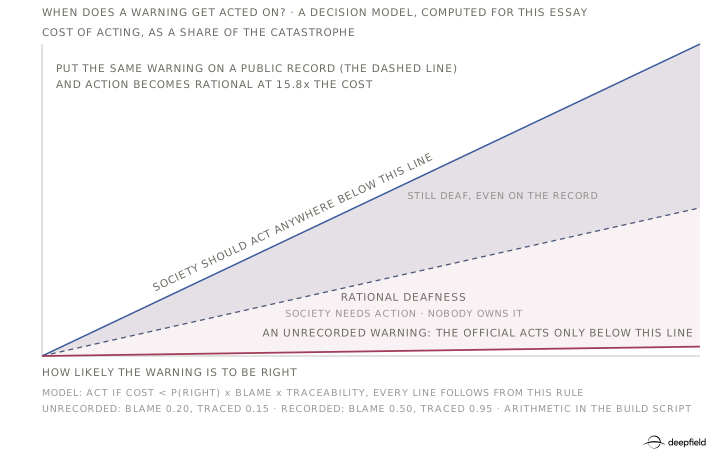
How to read this figure: it is computed from the stated model, not from data. Every point is a possible warning. Left to right, how likely the warning is to be right. Bottom to top, what acting would cost, as a share of the catastrophe it prevents. Society comes out ahead acting on any warning below the blue line. A rational official acts only below the rose line, because only a fraction of an ignored catastrophe ever lands on the one who ignored it: here, twenty percent of the blame, with a fifteen percent chance the buried warning is ever traced back to him. The shaded wedge between those lines is rational deafness: every warning society needed answered and no individual had a reason to own. The dashed line is the same official when the warning sits on a public record, where attribution is near certain and the record shows exactly what was knowable. The wedge does not close, but action becomes rational at 15.8 times the cost. The parameters are printed in the panel, and the arithmetic lives in the build script that draws the figure.
The arithmetic doesn’t spare rooms full of engineers. On the night of January 27, 1986, engineers at Morton Thiokol got on a teleconference with NASA and recommended, formally, that Challenger not launch the next morning: the forecast was too cold, and the rubber seals in the boosters had never been proven below 53 degrees Fahrenheit. One of them, Roger Boisjoly, had written a memo six months earlier warning that a seal failure could cost the crew their lives. The recommendation was heard. NASA pushed back, a Thiokol executive told his colleague to take off his engineering hat and put on his management hat, and the no-launch recommendation was reversed in a private caucus. Challenger flew the next morning at 36 degrees and broke apart 73 seconds later. The warning had been in the right room, with the right data, in front of the right decision-makers, twelve hours ahead of the event. Hearing was never the problem. The delay had owners; the risk had none.
Sometimes the debt is collected in advance. On December 30, 2019, an ophthalmologist in Wuhan named Li Wenliang messaged his medical school classmates that seven patients from a seafood market were in quarantine with an illness that looked like SARS, and told them to warn their families quietly. Within days the police summoned him and made him sign a statement admitting to spreading rumors. He went back to work, caught the illness from a patient, and died of it on February 7, 2020, thirty nine days after his warning. By then the thing he had described had a name and was on every continent. His country later apologized and honored him, which is what institutions do with warnings: punish them at the price of a rumor, then buy them back at the price of a martyr.
It’s worth knowing what the opposite looks like. Rick Rescorla ran security for Morgan Stanley in the World Trade Center. After the 1993 basement bombing, which he had told the Port Authority to expect, he concluded the towers would be attacked again, from the air next time, and he did the thing almost nobody does: he took the debt personally. For years he ran mandatory evacuation drills for the entire firm, traders included, marching thousands of people down dozens of flights of stairs with a stopwatch while other tenants complained about the lost hours. On the morning of September 11, 2001, while the loudspeakers in the South Tower told everyone to stay at their desks, Rescorla ignored them and ran the drill he had rehearsed for eight years. Around 2,700 Morgan Stanley employees walked out alive. He went back in for stragglers and didn’t come out. One man decided a warning was his to own, and it repriced the arithmetic for an entire company.
I don’t tell these stories to sneer at the officials. Deafness is not stupidity. It is policy, and in a noisy world it is almost defensible. For every Keswani there are a hundred confident men predicting disasters that never arrive, and an institution that acted on every alarm would tear itself apart. Institutions can hear fine. What they can’t afford is belief, because nothing on the surface of a warning distinguishes calibration from conviction. Both arrive with the same certainty in the voice. That is Cassandra’s real curse: nothing marked her apart from the frauds.
Which is why I think the deafness has a price, and the price can be engineered. A warning is exactly as dismissible as it is deniable afterward. Now imagine warnings that arrive carrying their own record: every previous call by the same source, right and wrong, committed in public before the outcomes, checkable by anyone. Two things change at once. The listener can finally price the warning, because it comes with a hit rate instead of a tone of voice. And the listener enters the record too: afterward, anyone can reconstruct what was knowable, and when, and who decided what. The debt stops being optional. Ignoring a calibrated warning becomes as owned, as named, as acting on a false one, and the wedge in the figure starts to close. Warnings will always be debts. The question is whether both sides of the ledger carry names.
Keswani’s warnings died in a weekly that nobody in power had to answer to. The Thiokol recommendation died in a caucus nobody outside the room could see. Li Wenliang’s died in a police station, at the price of a signature. Ignorance killed none of them. Unaccountability did, and unaccountability, unlike ignorance, is an engineering problem. Build the record, and hearing becomes cheaper than deafness. What the record can’t fix is the older problem underneath all of these, the one Bhopal and the Cape and Wuhan share: nobody, however honest, can watch everything at once. That one is next.