AN INDEPENDENT RESEARCH PROGRAM
Applications
DeepField is one instrument, and an instrument is defined by what it can be pointed at. This is the full catalog of what it’s being built to do. One caveat governs every line of it: the entries describe what the system does, and whether it does it well enough to sell is the open empirical question the current work exists to answer. Parts of the machinery run today. Most of it is under construction. None of it is sold until the record earns it. Each entry carries a small diagram, computed at build time from a model stated in the build script. They show what the product is. They are not measurements, and every one says so on its face.
A · CORE PREDICTION PRODUCTS
- Commodity price and supply predictions
- Forward predictions on commodity prices and supply conditions, copper, oil, and wheat first, delivered as full probability distributions, not point guesses, with stated confidence, a stated horizon, and the causal chain behind each call written out.
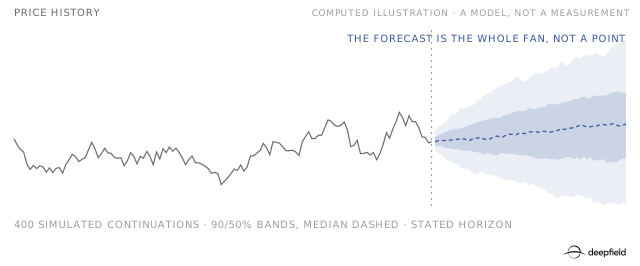 The grey line is the past. The blue fan is the forecast: every path the model considers plausible, with the middle path dashed. The wider the fan, the less certain the call.
 - Regime-change and tipping-point early warning
- Detection that a market is leaving its current regime, the statistical character of the world changing, before the break is obvious. Three stacked detectors: hidden Markov regime detection, critical slowing down monitoring, and a neural early-warning-signal detector. The product is time: knowing a transition is forming weeks before consensus does.
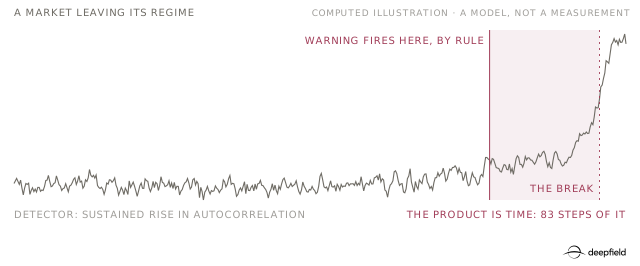 One noisy series, left to right in time. The rule fires at the solid rose line; the break arrives at the dashed one. The shaded span is the head start.
 - Cross-domain cascade theses
- Multi-step causal calls that connect domains: Chinese import regulation, Red Sea shipping stress, and smelter maintenance season composing into a copper supply disruption within sixty days. Signals propagate across domains and the causal chains assemble the thesis. This is the flagship intellectual product: the call nobody else’s siloed research produces.
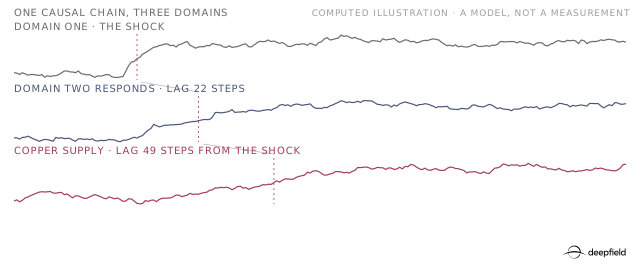 Three domains stacked in time. A shock crosses the top series first, moves the middle one 22 steps later, and reaches copper supply 49 steps after the start.
 - Time-priority access
- The core paid product. Every published prediction releases on a staged schedule, earliest to the subscribers who underwrite the work, then successively wider audiences, public last. What the early tiers buy is being early on a verified divergence, in the window before consensus converges. Capacity is capped per domain, so the alpha isn’t sold to fifty competitors at once.
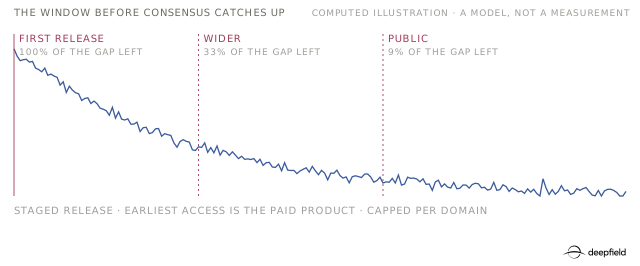 The blue curve is how far ahead of consensus a call is, decaying as the world catches up. Each marker is a release stage; earlier stages get more of the gap.
 - Confirmatory predictions
- Predictions that passed the confidence gate but agree with consensus: no divergence, so no headline value, sold as validation instead. Independent, verified confirmation of a thesis the client already holds. Low glamour, high retention.
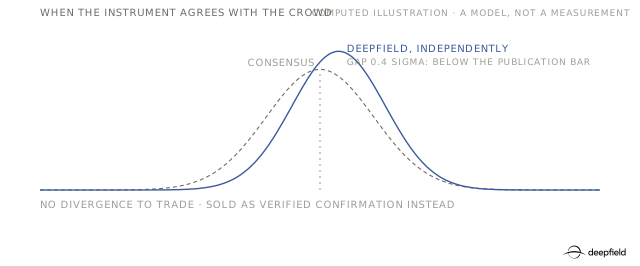 Two bell curves: the dashed one is what the crowd expects, the blue one is the independent forecast. They nearly coincide, so the call sells as confirmation, not news.
 - Lifecycle-managed predictions
- Every prediction is a live position, not a press release: confirmed, revised, or withdrawn as the world moves, with every transition signed, timestamped, and pushed to subscribers as it happens. Clients act on predictions knowing they’ll hear immediately when the system changes its mind.
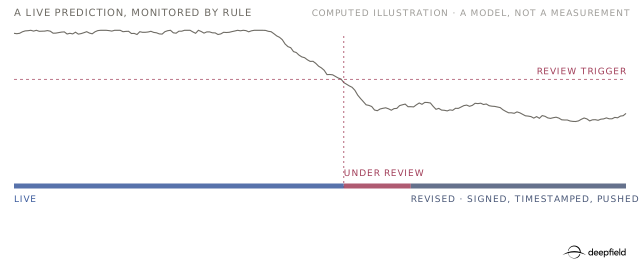 The wobbling line is the health of a prediction’s reasoning, watched over time. When it crosses the dashed trigger, the status bar below changes state automatically.
B · INSTITUTIONAL DECISION TOOLS
- Risk surface aggregation
- Cross-prediction exposure analysis: these seven of your positions share one causal dependency, and if that node breaks, they break together. It answers the institutional question no single prediction answers: what am I exposed to across everything DeepField is telling me?
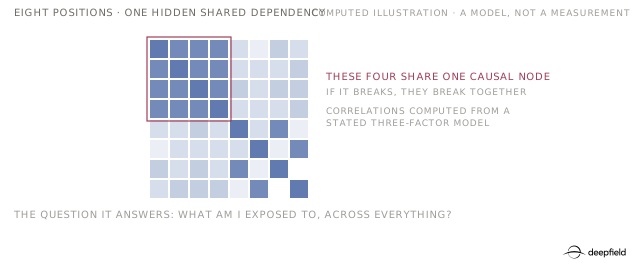 Each square is how strongly two positions move together, darker meaning more. The outlined block is four positions that secretly depend on the same thing.
 - Prediction replay
- Deterministic reconstruction of what the system believed at any past moment, with lookahead structurally impossible: show me how this would have behaved in March 2022. The due-diligence unlock: a fund audits the machine’s historical behavior instead of trusting a marketing deck.
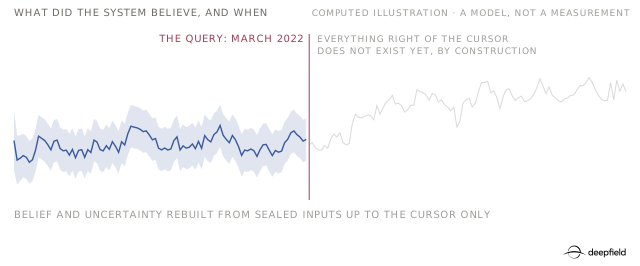 The blue band is what the system believed, rebuilt moment by moment up to the red cursor. The grey right half is the future the reconstruction is not allowed to see.
 - Correlation cluster display and alerts
- A live view of which active predictions are correlated, through shared causal ancestry or shared regime exposure, with alerts when the cluster structure shifts: portfolio-level situational awareness on the prediction book itself.
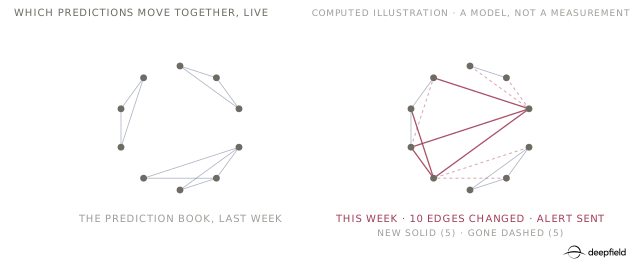 Each dot is an active prediction; lines connect ones that move together. Solid rose lines are new connections this week, dashed ones just vanished. That shift triggers the alert.
C · THE SIGNAL FEED
- The quant data feed
- A licensed, machine-readable data product for systematic desks that want inputs to their own models, not finished predictions: per-domain novelty scores, regime states with confidence, consensus-gap time series, cascade alert intensity, and aggregate risk-surface statistics. It sells features derived from DeepField’s instruments: never the predictions, never the instruments themselves.
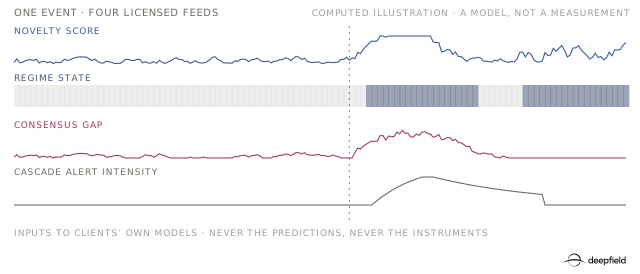 Four data streams reacting to the same moment, marked by the dotted line: a strangeness score, a regime flag, the gap to consensus, and a cascade alarm.
D · COMMISSIONED AND BESPOKE
- Scenario studies
- Commissioned forward simulations at institutional depth: model the global cascade if the Strait of Hormuz closes for thirty days, or stress our supply chain against a copper shock. The simulation machinery pointed at one client’s question, delivered as a study.
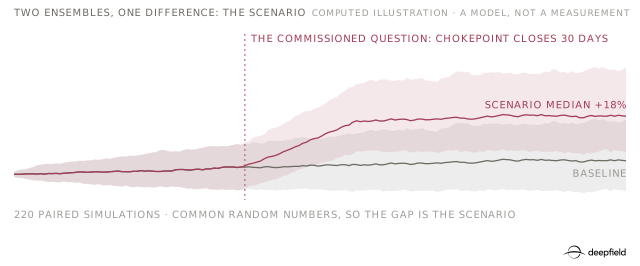 Two futures simulated with identical luck. Grey assumes nothing happens; rose assumes the chokepoint closes for thirty days. The gap between them is the scenario’s cost.
 - Commissioned domain expansion
- A client funds DeepField to build coverage of a domain it doesn’t yet watch, a commodity, a region, a regulatory environment: sensing build-out, data validation, shadow calibration, then published-domain status. The expansion cost becomes revenue, and the domain then becomes permanent product.
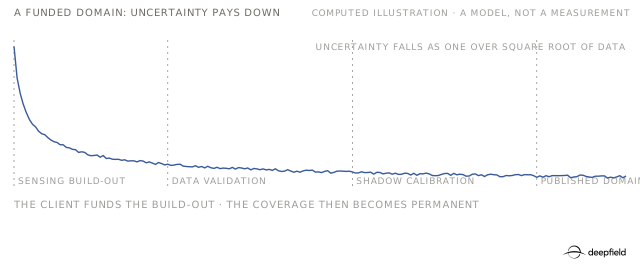 The curve is how uncertain the model is about a new domain, falling as observations accumulate through each build phase until the domain is fit to publish.
E · POLICY-ADJACENT PRODUCTS
- Policy-consequence forecasting
- Forecasts of what a government action does to markets: a tariff, an export control, a sanctions package, a subsidy, a strategic-stockpile action, and the price, supply, and substitution response that follows. Policy events become upstream signals, and the causal machinery projects the consequence. Buyers: trading houses, corporates, sovereigns.
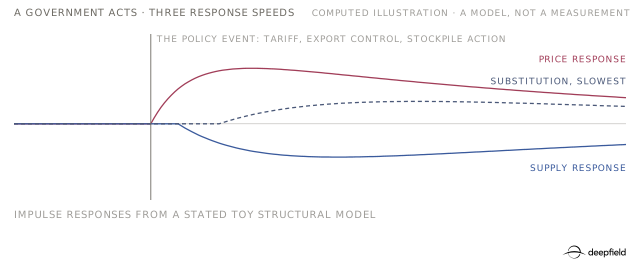 The vertical line is a government decision. The three curves are what follows: price jumps fastest, supply sags slower, substitution builds slowest of all.
 - Contingent-outcome forecasting
- Not who wins: what copper, grain, and energy do conditional on each outcome. Per-branch forecasts on an externally resolved trigger, an election, a policy vote, a court ruling, under a hard rule: no likelihood over the trigger outcomes themselves is ever published or derivable from what is. It captures what markets actually trade: the consequence, not the horse race.
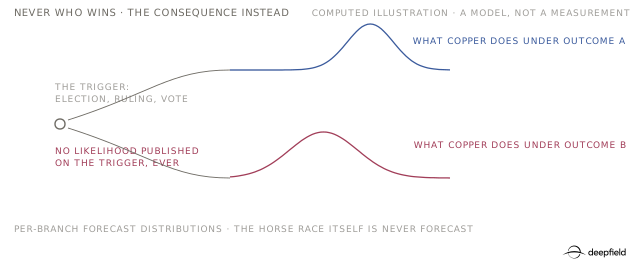 The circle is an event nobody forecasts here, an election or a ruling. Each branch carries its own full forecast of what copper does if that outcome happens.
 - Sovereign import-exposure and food and energy security profiles
- Country-level exposure analysis: a nation’s import-dependency graph run through the risk-surface machinery. Your food security has concentrated exposure to these three supply chains, and here is what stresses them. Buyers: governments, multilaterals, development banks.
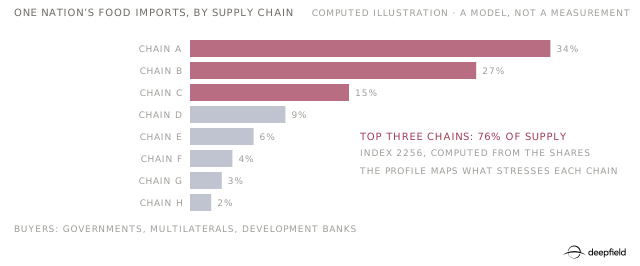 Each bar is one supply chain’s share of a nation’s food imports. Three chains carry 76 percent of the total: the map of where security concentrates.
 - Political-risk instability indices
- Country and region instability regime states with confidence, at coarse granularity, country by month, licensed as a signal-feed family: priors for insurers and reinsurers setting political-risk and trade-credit premiums. A hard granularity floor holds: never sub-national, never event-level.
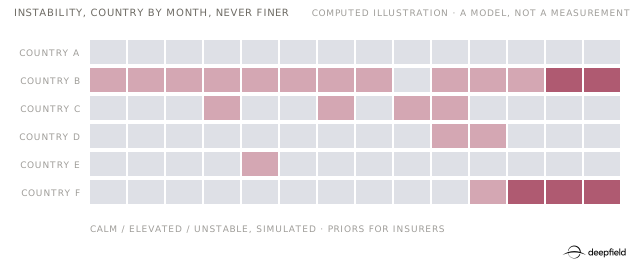 Each cell is one country in one month, shaded by how unstable its regime state is. The grid is deliberately no finer than that.
 - Chokepoint disruption probability
- Disruption-probability monitoring on the physical arteries of trade: straits (Hormuz, Malacca, Suez, Panama), rail corridors, refining capacity, port throughput, as binary event predictions of the form throughput below a stated level for a stated number of days. It feeds directly into cascade theses. Sold to trading houses, shippers, corporates, sovereigns.
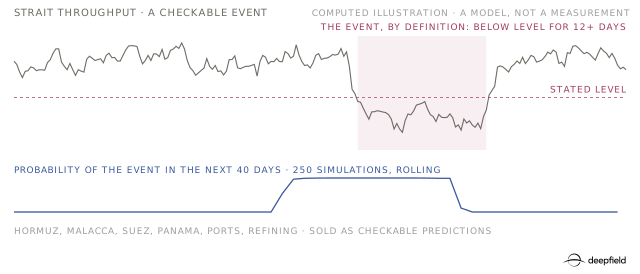 The top line is traffic through a strait; the shaded span is where it stays below the stated level long enough to count as an event. The blue line is the odds of that event, updating as evidence builds.
 - Policy-adjacent commissioned expansion
- The commissioned-expansion mechanism opened to policy domains: a government or institution funds coverage of a region, corridor, or policy environment it cares about, within the families DeepField accepts and never within the refused ones.
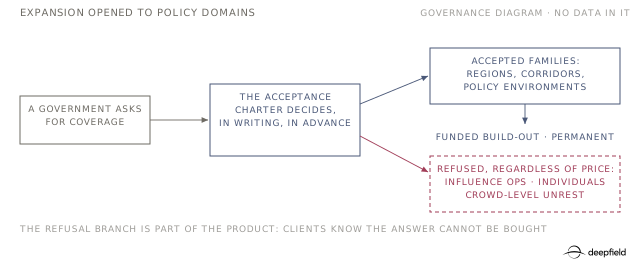 A request for new coverage flows through a written charter: accepted families get built and kept; the refused classes stay refused at any price.
F · THE META-PRODUCT
- The verified record itself
- The thing that makes the other eighteen sellable at a premium. Every prediction cryptographically committed before anyone sees it, suppressed and private ones included, so changing the books would show, even if we were the ones changing them. Calibration published bucket by bucket, and accuracy reported separately on the calls where DeepField disagreed with consensus, on a cohort sealed before outcomes were known. No prediction vendor on earth publishes these numbers. Every claim is checkable by someone who doesn’t trust us, and that is the moat: the record is itself the product.
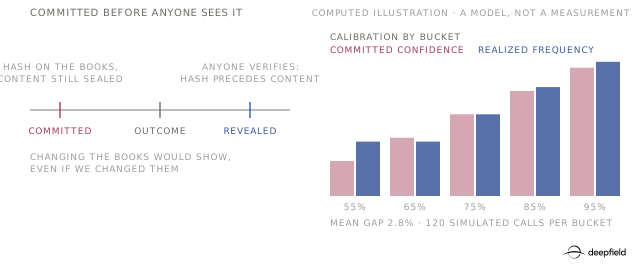 Left: a prediction’s fingerprint goes on the books before the outcome, so it can’t be rewritten quietly. Right: the confidence that was committed, in rose, next to what actually happened, in blue, bucket by bucket.
REFUSED WORK
There is work DeepField won’t take. The refusals are written down in advance, so they don’t get renegotiated when the money shows up: no influence operations, no message or persuasion testing, no unrest prediction sharp enough to point at a crowd, nothing about a named person or a small group, no election horse-race for its own sake. Some of this pays well. The answer stays no. The unit of study is the crowd, never the person, and the record is worth more than the revenue.
Each application is the same instrument pointed at a different question. The record is what makes them worth anything.