AN INDEPENDENT RESEARCH PROGRAM
Chaitanya Laxman
The future leaks
Bridges dance, grids rehearse, credit whispers. The first in a series on the strange habit reality has of announcing itself.
On the first of July, 1940, the state of Washington opened a bridge across the Tacoma Narrows, and the bridge began to dance the same day. Not sway. Dance. In a light wind the deck rolled in slow waves large enough that the car ahead of you would sink out of sight and rise again. The construction workers had already named it Galloping Gertie. Drivers paid the toll specifically for the ride. For four months the third longest suspension bridge on earth behaved like a carnival attraction, and then, on the seventh of November, in a wind of about forty miles an hour, it tore itself apart in front of a film camera.
Everyone remembers the collapse. The footage is one of the most watched engineering failures in history. What I can’t stop thinking about is the four months. The bridge announced its own death every day, in a language of humming cables and rolling pavement, to thousands of witnesses who found it charming. The future was audible under their tires. Nobody was listening in the way that mattered.
This would be a story about 1940s engineering, except that the same pattern keeps appearing in places that share nothing with bridges. In 2008 a team of ecologists began deliberately destabilizing a small experimental lake, adding predator fish season by season and watching the food web strain. Their instruments caught the warning more than a year before the ecosystem actually flipped: the lake recovered from small disturbances more and more slowly, and its fluctuations grew wider. It was stuttering before it fell. They published the whole thing in Science, a controlled experiment in hearing a collapse ahead of time.
There is a name for the pattern. Physicists and ecologists call it critical slowing down: as a system nears a tipping point its restoring forces weaken, so it recovers from small knocks more slowly, wobbles wider, and falls into step with itself. The same three symptoms have since been measured in lakes and ice cores, in the electrical weather of the brain minutes before some seizures, in the rhythm of a heart drifting toward certain kinds of failure. None of this is mystical. The groan of a structure losing its resilience is a physical signal, and physical signals can be instrumented.
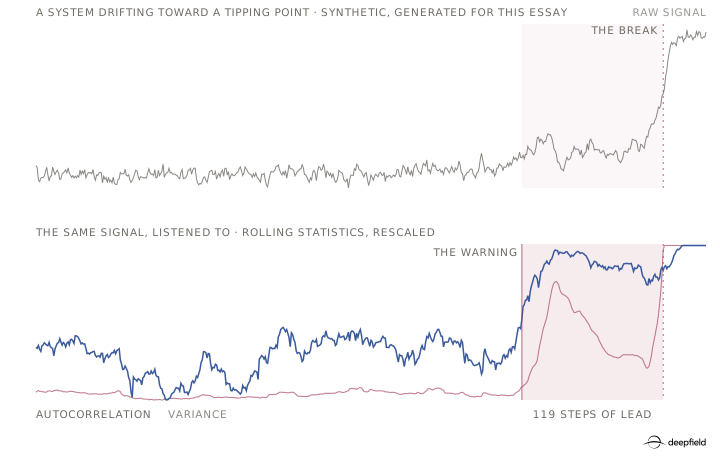
How to read this figure. It comes from a real simulation run for this essay, not a drawing. The top panel is what an observer would actually see: one measurement, plotted left to right, rattling like static for hundreds of steps and then breaking, at the marker labeled THE BREAK. The bottom panel listens to the same measurement with two running statistics. The blue line asks: how much does each wobble resemble the one before it? The rose line asks: how wide have the wobbles grown? Watch both creep upward long before anything visible happens above, because a system losing its grip recovers more slowly and swings more widely. The moment the blue line holds clearly above its own calm-period level, a fixed rule fires the marker labeled THE WARNING. That happens 119 steps before the break. The system tips on its own, and the rule was set before the run, so nothing here is placed by hindsight.
Machines tell the same story, and I grew up on the grid that proved it. At the end of July 2012, India’s power network collapsed on two consecutive days: first the northern grid, then half the country, six hundred million people, the largest blackout in human history. It didn’t come from nowhere. The system had spent weeks under visible strain, frequency sagging, states drawing far beyond schedule, transmission corridors running hot. And the first day’s collapse was the loudest warning any system has ever been given. The second day arrived anyway.
Markets may be the most talkative systems of all. The 2008 crisis is remembered as a thunderclap: Lehman Brothers dead on a September morning, the world economy seizing within weeks. Read the tape backward and the collapse spent two years announcing itself. American home prices stopped rising in the middle of 2006 and quietly turned down. In February 2007, HSBC issued the first profit warning in its history over souring mortgage loans. In June, two Bear Stearns funds built on those loans died. In August, BNP Paribas froze three of its funds with the now famous admission that it could no longer price what was inside them, and the rate banks charge each other for overnight trust leapt in a single morning. In September, depositors queued on the pavement outside Northern Rock, the first run on a British bank in a century and a half, a full year before Lehman. Bear Stearns itself was carried out of the building in March 2008, six months early. Every one of those signals was public. The queue outside Northern Rock was literally photographed. And the event, when it finally came, was still received as a surprise.
India ran the same tape a decade later. Through the summer of 2018, IL&FS, one of the most trusted names in Indian infrastructure finance, was already missing small payments while its ratings still said AAA. The first defaults arrived in June and stayed out of the headlines. By September, when the big one landed and credit froze for every shadow lender in the country, the paper trail of warnings was three months long. Anyone reading the ledgers instead of the labels had a full season’s notice.
And sometimes the leak is not subtle at all. On the morning of December 26, 2004, seismometers around the world registered a magnitude nine earthquake off Sumatra within minutes. The wave it raised took roughly two hours to cross the Bay of Bengal to the Tamil Nadu coast. Two hours. The future was already written and moving at the speed of an airliner, and there was no system whose job it was to connect the instruments to the shore. India built one afterward, the way warning systems are usually built: afterward.
None of this is even a new ambition, and it isn’t a foreign one. After the failed monsoon of 1899 and the famine that followed, the Indian weather service set a mathematician named Gilbert Walker loose on the problem of anticipating the rains. He spent two decades correlating pressure records from across the planet and surfaced the Southern Oscillation, the slow seesaw of Pacific pressure that still anchors seasonal forecasting today. Long-range forecasting was not born in a trading firm. It was born here, out of hunger.
I want to be careful, because this idea attracts nonsense the way honey attracts flies. Not everything leaks. The Sumatra earthquake itself announced nothing; what was knowable that morning was everything after it. Decades of hunting for reliable earthquake precursors have humbled everyone who tried, and some futures really are silent. An honest program has to say so out loud. The claim that survives the caveats is narrower and, to me, stranger: a large class of the futures we care about most, the collapses and crashes and cascades, does emit measurable signatures first, and those signatures sit scattered across feeds and filings and sensor networks that no one assembles in one place.
Which leaves the question I haven’t been able to put down since I first watched the Tacoma film. If a bridge can dance for four months, a grid can rehearse its own collapse a day in advance, a lender can default quietly all summer, and a wave can be two hours from shore with its arrival already computed, why is the world still surprised by almost everything? I don’t think the answer is only technical. Nobody can watch everything at once. Listening is expensive. And a warning heard is a warning owned: afterward, someone will ask what you did about it. Each of those answers deserves an essay of its own, and they are where this series is going.
For now the observation is enough, and I find it changes how the news reads. The future leaks. Most of the world finds out afterward.