
AN INDEPENDENT RESEARCH PROGRAM
Chaitanya Laxman
Paying for silence
Indonesia's tsunami buoys had been dead for six years when Palu drowned. Odisha paid through fourteen quiet years and cut ten thousand deaths to 46. On what listening costs, and who can afford it.
On the evening of September 28, 2018, a magnitude 7.5 earthquake tore along the coast of Sulawesi in Indonesia, and the sea followed it into the city of Palu. The warning system did what it still could. Within five minutes an alert went out, calling for waves of half a metre to three metres; the waves that came ran to six metres and more. Thirty four minutes after issuing the warning, the agency lifted it, and by its own account the water had already come ashore by then. The earthquake and the sea together killed an estimated 4,340 people.
Then the accounting began, and one detail refused to stay small. Indonesia’s open water was supposed to be watched by 22 deep-ocean buoys, instruments that feel a tsunami crossing the deep sea and report it faster than it travels. They had been donated by the United States, Germany, and Malaysia after the 2004 Indian Ocean tsunami killed nearly a quarter of a million people. On the night Palu drowned, not one of them was working. Not one had worked since 2012. Vandalized, stolen for parts, and above all unmaintained: the disaster agency’s own spokesman said the money for them had shrunk year after year. The modern replacement, seafloor sensors on fiber optic cable, had been stalled in its testing phase for years, waiting on a final one billion rupiah of funding. That’s about sixty nine thousand US dollars.
I want to be exact about what the buoys do and don’t explain, because they became a symbol within days, and symbols get sloppy. Palu sits at the end of a long narrow bay, minutes from the fault, and part of the wave was raised by landslides under the bay itself. Deep-ocean buoys watch the far field; even a perfectly maintained network would likely not have saved most of those who died that evening, though it might have kept the agency from cancelling its warning blind, with nothing in the water to say whether the sea was still coming. The dead buoys didn’t kill Palu. They tell you something worse: fourteen years after the deadliest tsunami in recorded history, on one of the most tsunami-prone coastlines on earth, the ear built in the year of grief had been allowed to go quietly deaf, for want of a maintenance line in a budget.
The first essay in this series claimed that the future leaks. The second claimed that warnings rot unless a person owns them. The third claimed that the decisive signals fall between institutional mandates, where nobody is paid to look. All three arguments run into the same wall, and the wall is money. Listening costs it continuously, and it costs it in a pattern almost perfectly designed to defeat the way institutions budget. There are three costs, and they arrive in rising order of cruelty.
The first cost is the obvious one: vigilance pays out in silence. A warning system’s product, on nearly every day of its life, is nothing happening. India built a tsunami warning centre in Hyderabad within three years of 2004, and it has watched the Indian Ocean around the clock since 2007; on almost every one of those days, its finding has been that today is fine. A budget committee reading two decades of quiet can draw two conclusions: the system works, or the system was never needed. The two look identical in a spreadsheet, the second one is cheaper, and no experiment separates them until the experiment arrives on its own schedule and grades everyone in public. So the decay is slow and blameless. A maintenance contract lapses here, a technician isn’t replaced there, a satellite link drops to a cheaper tier. The buoys off Indonesia didn’t die in a decision anyone took. They died line item by line item, through years when the sea stayed flat and the money looked wasted precisely because it was working.
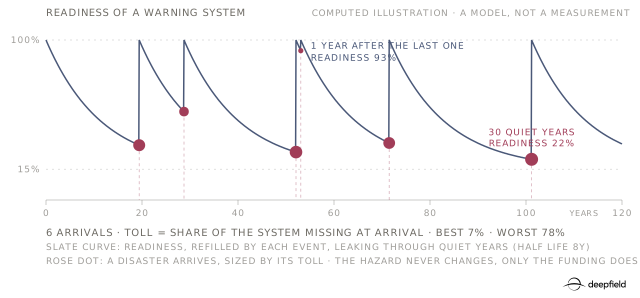
How to read this figure: it is computed from the stated model, not from data. The slate curve is a warning system’s readiness, the share of it that is funded, maintained, and staffed, followed across 120 modeled years. Disasters arrive at the rose dots, by a seeded random process with an average gap of 22 years; nothing about their timing is chosen by hand. Each arrival refills readiness to full, because money is easy to find in the year of a funeral. Through the quiet years that follow, readiness leaks toward a neglect floor of fifteen percent with a half life of eight years, a rate that stands for the slow loss of budgets, parts, and people; changing it changes the sizes below, not the shape. The size of each rose dot is the toll: the share of the system missing at the moment it was needed. In this run, a disaster that lands one year after its predecessor finds the system 93 percent ready, and the one that lands after 30 quiet years finds it 22 percent ready. The hazard never changed. The funding did.
The second cost lands on the day the system speaks. In September 2005, three weeks after Katrina drowned New Orleans, Hurricane Rita spun up to a category five and pointed at Texas. More than two and a half million people got on the road. The storm weakened and landed east, near the Louisiana line, and Texas counted three deaths from Rita’s wind. The evacuation killed about ninety: people who died of heat in gridlocked cars with the air conditioning off to save fuel, patients who died being moved out of hospitals and nursing homes, and twenty three assisted-living residents who burned on Interstate 45 south of Dallas when their bus’s overheated brakes set it alight and the oxygen cylinders aboard fed the fire. Every one of those deaths was billed, publicly and by name, to the decision to warn. The deaths a warning prevents are billed to no one, because they don’t happen. The ledger of speaking up only ever records one side.
The United States had already run that lesson at national scale. In February 1976, an Army recruit at Fort Dix died of a flu that looked like a descendant of 1918, and the president went on television to ask that the whole country be vaccinated. About forty five million Americans took the shot in ten weeks, the fastest vaccination campaign the country had ever run. The pandemic never came. What came instead were several hundred cases of a rare paralysis linked to the vaccine, a suspended program, years of lawsuits, and a fired CDC director. The people who ran it joked, bleakly, that it was the first time anyone had been blamed for an epidemic that did not happen. And in case anyone concluded that silence is at least safe, Italy closed that exit in 2012, when a court convicted six scientists and a civil protection official of manslaughter for the reassurances given days before the L’Aquila earthquake killed 309 people. The judge found that twenty nine of the dead had stayed indoors that night because the experts had sounded calm. The scientists were acquitted on appeal two years later; the official’s conviction stood. Read the two cases together, the way every forecaster on earth has: speak and be wrong, and the evacuation’s deaths are yours; reassure and be wrong, and the reassurance’s deaths are yours. The only forecast that can never be punished is a vague one. Vagueness is not a stylistic failure in official warnings. It is armor.
The third cost decides who ends up owning ears at all. Listening gets funded where whoever pays for it can keep what it hears. Investment funds have for years bought satellite photographs of retailer parking lots and run car-counting software over them, trading the quarter’s revenue before the company announces it. That is exactly the kind of listening this series is about, a faint, boring, continuous signal, worthless on any given day and priceless across enough of them, and it gets funded without argument, because every dollar it earns lands on the fund that paid for it. A tsunami buoy is the opposite case. Its value lands on fishermen who will never pay the agency back, scattered across coastlines and decades. Economists call that a public good, and the ending has been known for a century: markets starve it, however high the stakes. So the world’s listening follows capture, not stakes. The sharpest ears private money can build point at parking lots. The buoys point at the sea, and rust.
None of this means the bill can’t be paid. It means someone has to decide to pay it, and then hold the decision through the quiet. In October 1999, a super cyclone came ashore in Odisha with winds near 260 kilometres per hour and killed 9,885 people by the official count; a single district, Jagatsinghpur, lost more than eight thousand. Odisha decided that arithmetic was intolerable and spent the next fourteen years paying against silence: hundreds of concrete cyclone shelters along the coast, embankments, a state disaster authority with no other job, evacuation drills in coastal villages year after year, about 255 million dollars of patient spending with the World Bank alongside. In October 2013, Cyclone Phailin arrived on nearly the same coast at comparable strength, and Odisha and its neighbours moved roughly a million people inland before landfall, the largest evacuation India had run in twenty three years. The dead numbered 46, floods included. The same coastline, a comparable storm, fourteen years apart: 9,885, then 46. Both storms were forecast. The difference is that the second forecast landed on fourteen years of paid-for readiness, built to catch it.
I think about Odisha and the buoys in the same breath, because DeepField is, among other things, a bet about this wall. An instrument that listens wide, across markets and supply chains and the slow build-ups this series keeps returning to, costs money continuously and produces its worth in bursts, sometimes years apart. Nobody funds that out of virtue for long; the buoys are the proof. My bet is that the private value of early knowledge can be made to carry the public weight of the record: the buyers who can price a few weeks of foresight fund the instrument’s width, and in exchange the record stays public, every call committed cryptographically before the outcome, misses preserved beside hits, checkable by people who never paid a rupee for it. What the instrument is, the public methods it composes and the nineteen jobs it’s being built to do, is written plainly across this site; only the wiring stays private. That trade is the only structure I know of where the listening survives the quiet years and the public still gets to grade what was heard.
Indonesia, for what it’s worth, found the money after Palu. New buoys, redesigned to shrug off vandals, went into the water through 2019, and parliament added roughly a trillion rupiah for detection the year after. By January 2021, officials were explaining that none of the new buoys were working either: two damaged within six months of deployment, two more simply gone from the sea. The sawtooth in the figure is a real shape, and budgets trace it everywhere until someone changes the incentives instead of the size of the grief. Silence is the most expensive thing a civilization buys, and it buys it twice: once when it pays for the watching, and once, at a far worse price, when it doesn’t. Next in this series: once someone does pay for the ear, how would anyone know it hears? What it means to keep score on a forecaster, and why almost nobody does.