AN INDEPENDENT RESEARCH PROGRAM
Chaitanya Laxman
Nobody lied
The Fed chair told the truth about subprime. The WHO told the truth about Wuhan. Every watcher told the truth about their own watchtower, and the future walked between them.
On March 28, 2007, the chairman of the Federal Reserve sat before Congress and said the problems in the subprime mortgage market seemed “likely to be contained.” By that morning, the index that tracked subprime mortgage bonds had been falling since January, hard enough that the traders who priced it had stopped calling it a dip. Eighteen months later, Lehman Brothers failed and the world economy seized.
There are two cheap ways to read that morning, and the internet loves both. He lied. Or he was a fool. I think the record supports neither, and that the true reading is worse. The Federal Reserve watches a particular tower’s worth of world: aggregate bank capital, national employment, the statistics of the system it regulates. From inside that tower, the sentence was defensible; the banks were capitalized, and subprime was a small fraction of their assets. The collapse wasn’t assembling inside his tower. It was assembling between towers: in repo desks that weren’t his mandate, in mortgage originators that weren’t his supervisees, in an index most of Congress had never heard of.
The same shape repeats wherever you look, once you know to look for it. On January 14, 2020, the World Health Organization reported “no clear evidence of human-to-human transmission” of the new coronavirus. Two weeks earlier, a Wuhan ophthalmologist had already warned his classmates about a cluster of SARS-like cases, and that same night an international outbreak mailing list flagged an undiagnosed pneumonia in the city. The WHO’s tower is official member-state reporting, and it reported that tower truthfully. The virus wasn’t traveling through official channels. It was traveling through a chat group, a market, and an airport.
Or 2021, when the word of the year at the Federal Reserve was “transitory.” The models in that tower were anchored on a decade in which inflation refused to rise no matter what anyone did. The inflation wasn’t in the models. It was in used-car auctions, container queues outside ports, and stimulus checks meeting empty shelves. After months of five percent prints, the chairman told the Senate it was “probably a good time to retire that word.” The tower updated honestly, in the end. It was just never pointed at the places where the thing was happening.
India learned this one in the hardest possible way. When the 2004 tsunami crossed the Bay of Bengal, seismometers worldwide had registered the earthquake within minutes. The Pacific has had a tsunami warning center since the 1940s. The Indian Ocean had none, so the knowledge and the shore never met. Every instrument told the truth. There was simply no tower whose job was the two hours in between.
I want to be precise about the claim, because it is not an excuse for anyone. Some officials do lie, and some are fools, and the record should catch both. The claim is structural: the system fails even when every single watcher is honest and competent, because institutions see what they are mandated, funded, and legally permitted to see, and catastrophes are almost by definition cross-domain events. A mortgage product becomes a funding panic becomes a trade collapse. A market cough becomes a pandemic becomes a supply shock. The event is the composition, and the composition is nobody’s job.
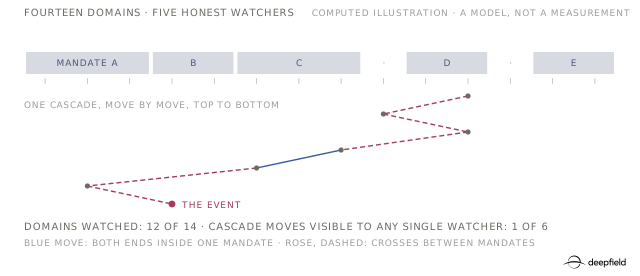
How to read this figure: it is computed from a stated model, not from data. The grey bands along the top are five watchers, each honestly covering its own mandate of domains; twelve of the fourteen domains are watched. The zigzag below is one cascade, moving step by step from domain to domain, top to bottom. A blue segment is a move that both starts and ends inside one watcher’s mandate: someone’s job. A rose, dashed segment crosses between mandates: nobody’s job. In this run the watchers cover twelve of fourteen domains and still see only one of the cascade’s six moves, because coverage of domains is not coverage of connections. The counts are computed by the build script, and the walk is seeded, not drawn.
The arithmetic is the ugly part. Fourteen domains make ninety one possible pairs; watch twelve domains with five honest institutions and you still hold only a handful of those pairs inside any single view. Add more analysts and you add more towers, but the pairs grow quadratically while mandates grow one at a time. You cannot staff your way across the gaps. Every institution that has tried has ended up where they all end up: perfectly informed about its column of the world, structurally blind to the seams, and sincerely surprised on schedule.
This is also why your feed feels haunted after every disaster. Within days, someone finds the warning that was there all along: the journalist’s article, the doctor’s message, the index that had been screaming for weeks. The comforting explanation is negligence, because negligence can be fired. The truer explanation is that the warning was seen, by someone honest, whose job ended one domain short of it mattering.
Which is why I think this is an instrument problem, not a personnel problem. Human institutions cannot hold the between; something that watches the connections themselves, continuously, across mandates, has to be built as a machine. And a machine like that inherits the obligation this series keeps circling: if it is going to claim the width no human watcher can have, it owes the public its record, committed before outcomes, misses included, scored precisely where it disagreed with everyone else. Otherwise it is one more tower with better marketing.
The watchers told the truth. The truth was standing in the wrong tower, and the future walked between them. Next in this series: what listening actually costs, and who can afford it.